Gluco6 Official Website › Journal › What is Sukre in Gluco6
What Is Sukre in Gluco6? The Trade Name, the Trademark and the Rat Study
Sukre is the first name on the Gluco6 ingredient list and the one the seller leads with. Few people have heard of it. Here is what is on record and what is not.
Sukre is a branded name, not a standard ingredient. A US trademark record ties it to an acacia hydrolysate, and the supplier calls it purified l-arabinose. One paper, a 28-day rat study paid for by the trademark owner, names Sukre. No human trial of Sukre exists, and Gluco6 prints no amount for it.
- What it is: the seller’s branded compound name, listed first on the label.
- Trademark: SUKRE, registered 17 September 2024 to Compound Solutions, Inc., Carlsbad, California.
- Goods named in the record: an additive made from acacia hydrolysate.
- Published safety study: 28 days, in rats, funded by the trademark owner.
- Human trials of Sukre: none.
- Amount in Gluco6: not published.
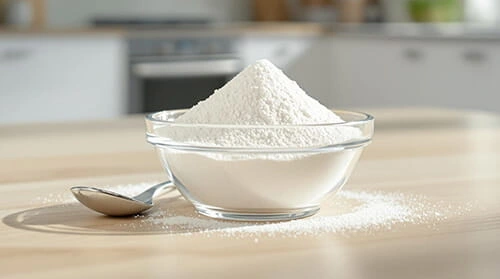
What is Sukre, in plain words?
Sukre is a name a company owns. It is not the name of a plant or a chemical you could look up in a textbook. On the Gluco6 label it sits first in a list of six, inside one 525 mg proprietary blend.
The seller’s own material gives no botanical source, no chemical identity and no amount for it. So the label alone cannot tell you what the first name stands for. To learn more you have to go outside the bottle, to public records.
What does the trademark record say?
The US Patent and Trademark Office lists SUKRE under serial number 97260422 and registration number 7508367. It was registered on 17 September 2024 to Compound Solutions, Inc., in Carlsbad, California.
The goods line reads like a catalogue entry: an additive component, namely acacia hydrolysate, for use in making foods, medical foods, drinks and supplements. The supplier of the ingredient calls the material purified l-arabinose.
| Source | What it says | What it leaves out |
|---|---|---|
| The Gluco6 bottle | Sukre is the first of six names in a 525 mg blend | Source, identity and amount |
| The trademark record | An acacia hydrolysate additive, owned by Compound Solutions, Inc. | Whether Gluco6's Sukre is that exact material |
| The supplier’s description | Purified l-arabinose | An amount in Gluco6 |
| The one published safety paper | A 28-day study in rats, with no adverse effects found up to 7,200 mg/kg a day | Any human data |
Gluco6 does not say its Sukre is the trademark-listed material. A reader can reasonably suspect it, but the label does not confirm it.
What does the rat study show, and what does it not?
The paper is a genotoxicity and repeat-dose 28-day oral toxicology study of Sukre, described as a purified l-arabinose from acacia hydrolysate. It found no adverse effects at up to 7,200 mg/kg a day. Its authors disclose that the trademark owner paid for the work.
That is useful as a first safety signal. It is not a human trial, and it was not designed to test blood sugar. Rats given a very large dose for 28 days tell you little about a person taking a capsule every morning for months, or about how Sukre behaves alongside five other ingredients.
No published human trial of Sukre exists, on blood glucose or on anything else.
What do the l-arabinose trials suggest?
Because the supplier calls Sukre purified l-arabinose, it is fair to look at studies of l-arabinose. Three are cited on this website, and they point three different ways.
- Krog-Mikkelsen 2011: 3 g of l-arabinose with a 75 g sucrose drink in 15 healthy men cut the glucose peak by 11 per cent.
- Pasmans 2022: 7.5 g with 50 g of sucrose slowed the appearance of glucose in a double-blind crossover trial.
- Halschou-Jensen 2015: l-arabinose folded into a mixed breakfast changed nothing in glucose or insulin responses.
Notice the scale. These doses are measured in grams and were taken beside a sugar load. The whole Gluco6 blend, all six names together, weighs 525 mg. The label does not say how much of that is Sukre, so none of these results can be pinned to the capsule.
Does it matter that Sukre is listed first?
It might. Under the US rule for supplement panels, the names inside a proprietary blend are listed heaviest first. Gluco6 lists Sukre at the top, then chromium, cinnamon, TeaCrine, gymnema sylvestre and green tea.
If the panel on your bottle follows that order, Sukre would be the heaviest of the six, and green tea the lightest. No weight is printed beside any name, so this is a reading of order and not of amount. This desk has not seen a back panel with more detail than the front, so check your own bottle when it arrives and write down what it shows.
Even a heavy share of 525 mg is small beside the gram-sized doses used in the l-arabinose trials above. That gap is one more reason not to borrow a trial result for this capsule.
How does the seller’s story fit with the evidence?
The seller’s page describes the lead ingredient as a breakthrough and builds its mechanism around a phrase of its own about GLUT-4 receptors. Those are the seller’s words and this website quotes them only as that.
In those studies l-arabinose does its work in the gut. It blunts sucrase, the enzyme that cuts table sugar apart, so a smaller share of a sucrose drink reaches the blood as glucose. That is a different place and a different job from the receptor story. The two accounts do not join up, and no published work ties the six names to the receptor idea in people.
How should a careful reader treat the first name on the label?
- Treat Sukre as a brand name until the seller prints a source, an identity and an amount.
- Ask the order desk on +1 (302) 200-3480 whether more detail exists. Note what you are told.
- Remember that the 525 mg total is a ceiling. It is not a dose for Sukre or for any other name.
- If you take medicine for blood sugar, show the label to your prescriber. Any ingredient with a glucose story is worth a mention.
- Judge the capsule on your own notes during the 60-day guarantee, not on the name alone.
Frequently asked questions
What is Sukre?
A branded compound name owned by Compound Solutions, Inc. A US trademark record ties it to an acacia hydrolysate additive, and the supplier describes it as purified l-arabinose.
Is Sukre the same as l-arabinose?
The supplier calls it purified l-arabinose. Gluco6 does not state that its Sukre is that material, and it prints no source or identity.
How much Sukre is in Gluco6?
Not published. The label gives one 525 mg total for all six ingredients and does not split it.
Has Sukre been tested in people?
No human trial of Sukre exists. The one paper that names it is a 28-day study in rats, funded by the trademark owner.
Does Sukre lower blood sugar?
This website cannot say so. The l-arabinose trials give mixed results at doses measured in grams, and the amount in Gluco6 is unknown.
Is Sukre safe to take every day?
The rat study found no adverse effects at the doses used, but there is no human safety data. Ask your doctor, especially if you take medicine for blood sugar.
Sources cited in this article
- United States Patent and Trademark Office, Trademark Status and Document Retrieval. SUKRE, US Serial Number 97260422, Registration Number 7508367, registered 17 September 2024 to Compound Solutions, Inc., Carlsbad, California. https://tsdr.uspto.gov/#caseNumber=97260422&caseSearchType=US_APPLICATION&caseType=DEFAULT&searchType=statusSearch
- Dziwenka M, Emmel KV. Genotoxicity and Repeat-Dose 28-day Oral Toxicological Evaluation of Sukre, a Purified l-Arabinose From Acacia Hydrolysate. Int J Toxicol. 2026;45(2):190-197. https://pubmed.ncbi.nlm.nih.gov/41093367/
Our view
Sukre is a good example of why a name is not an amount. It sounds scientific, it has a real trademark and one real paper, and it still tells you very little about what is in your capsule.
That does not make Gluco6 bad. It means the first line of the label asks for a measure of trust. Use the guarantee window, keep notes and bring the label to your doctor if you have any medical question.
Medical note. Gluco6 is a dietary supplement for healthy adults aged 18 and over. It is not FDA approved, and no dietary supplement is. It does not treat, prevent or manage diabetes or prediabetes, and it is not a substitute for prescribed medicine. If you take insulin, a sulfonylurea or a meglitinide, or any other medicine for blood sugar, speak to the clinician who prescribes it before the first capsule. Do not change a prescribed dose because you started a supplement. Ask a doctor about any medical question this page raises.