Gluco6 Official Website › Journal › The four Gluco6 label claims
What Do the Four Gluco6 Label Claims Actually Mean?
Four short lines sit on the front of the bottle. This guide reads each one slowly, explains the rule behind the wording and shows where the line is drawn.
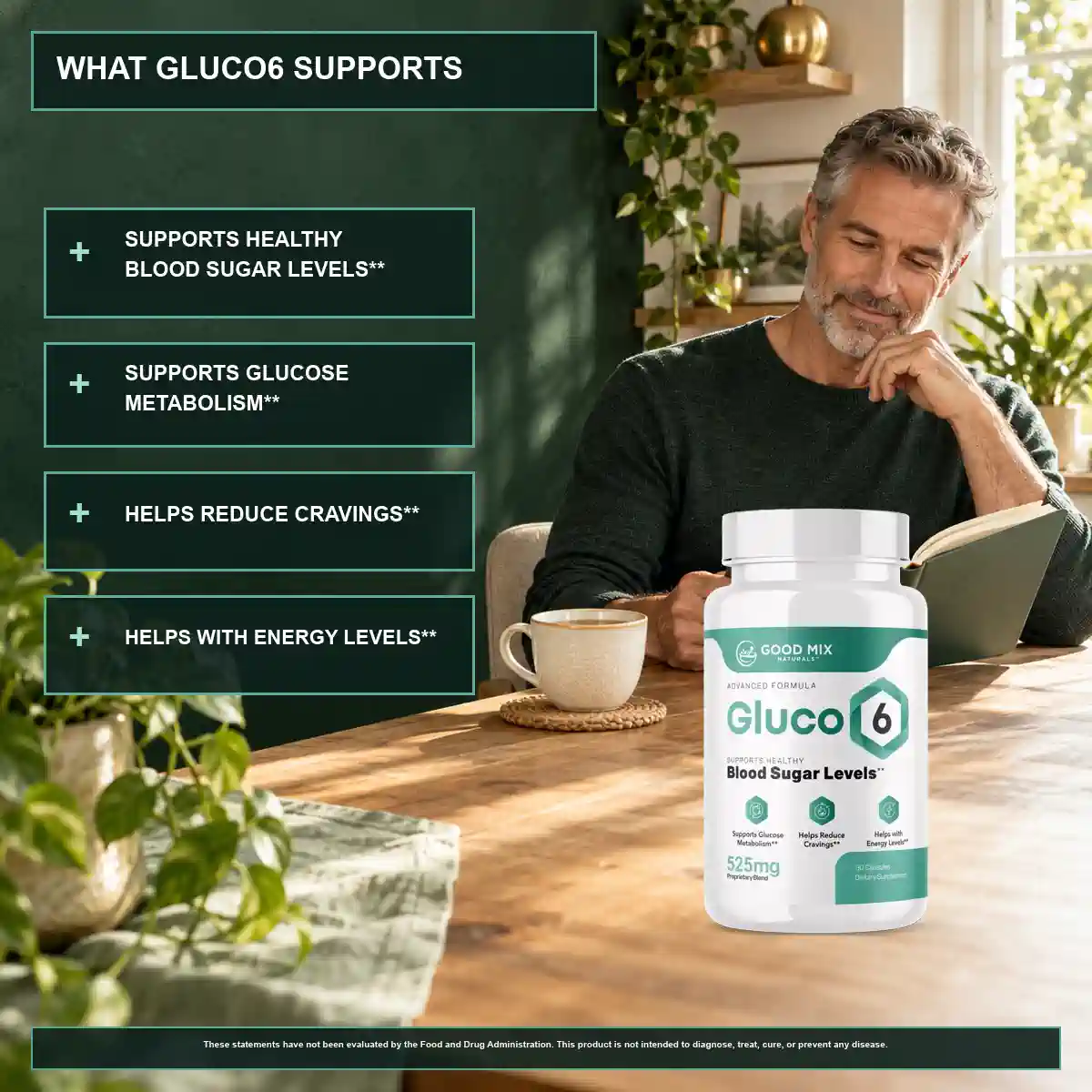
The Gluco6 bottle makes four claims: supports healthy blood sugar levels, supports glucose metabolism, helps reduce cravings and helps with energy levels. They are structure and function statements. They describe support for normal body processes. They do not say the capsule treats, prevents or manages any disease, and the FDA has not evaluated them.
- Claim 1: Supports Healthy Blood Sugar Levels.
- Claim 2: Supports Glucose Metabolism.
- Claim 3: Helps Reduce Cravings.
- Claim 4: Helps with Energy Levels.
- Missing from all four: a number, a timescale or a named group of people.
- Required wording: These statements have not been evaluated by the Food and Drug Administration. This product is not intended to diagnose, treat, cure or prevent any disease.
What does the word supports really mean?
All four lines lean on a soft verb. The first two say supports. The last two say helps. None says lowers, controls, fixes or manages.
That choice is not an accident. US rules allow a dietary supplement to describe how an ingredient affects the normal structure or function of the body. They do not allow a supplement to claim it treats, prevents or mitigates a disease. A supplement that did that would be treated as a drug. The FDA’s own example of an allowed claim is that calcium builds strong bones.
So when you read supports healthy blood sugar levels, read it as a statement about normal, healthy function. It is not a statement about diabetes.
How should you read each of the four lines?
| Claim on the bottle | Plain reading | What it does not say |
|---|---|---|
| Supports Healthy Blood Sugar Levels | The capsule is offered as a daily companion for normal glucose habits | That it lowers a reading or treats high blood sugar |
| Supports Glucose Metabolism | It is offered as support for the way the body moves and uses glucose | How, how much or how fast |
| Helps Reduce Cravings | It is offered as help with the urge to eat sweet things | That cravings vanish, or by when |
| Helps with Energy Levels | It is offered as help with day-to-day energy | That it is a stimulant, or that it is not |
Two of the four are about glucose, one is about appetite and one is about energy. The cravings and energy lines are the ones a person can notice from week to week, so they are the easiest to keep notes on.
Which rules sit behind the wording?
Three public sources explain the frame. This website cites them and no more.
- FDA structure and function guidance. A maker may use a statement of this kind without pre-approval, but it must carry the line that the FDA has not evaluated it. That is the reason for the double asterisk and the footnote.
- 21 CFR 101.93. This rule marks the line between a structure and function claim and a disease claim. Diabetes is a disease, so a claim to treat it would turn a supplement into a drug.
- FTC health products guidance. The FTC governs advertising and expects competent and reliable scientific evidence behind health claims, generally controlled trials in people.
The finished capsule has never been tested in a published trial, so we stop at the four printed lines.
Why does each claim end in two asterisks?
On the seller’s artwork every claim carries a double asterisk, and a footnote answers it. The footnote says these statements have not been evaluated by the Food and Drug Administration, and that the product is not intended to diagnose, treat, cure or prevent any disease.
That wording is the price of making a structure and function claim. A maker also has to tell the FDA within 30 days of first using such a statement. None of this is an approval. It is a labelling rule, and the footnote is how the rule shows up on a bottle.
You can use the footnote as a test on any supplement page. If the claims are strong and the footnote is missing, ask why.
Does the seller’s own page say more than the bottle?
Yes. The seller’s sales page goes well beyond the four lines, including promises about body weight and a named mechanism. Those are the seller’s words. None of that is printed on the bottle, and we do not adopt it.
The practical rule is simple. The bottle travels with the product into your home, and its four lines are the claim. If a page or an ad promises more than the bottle does, treat the extra as marketing.
What has actually been studied for each line?
The evidence relates to single ingredients, not to the capsule. Each study named on this website used an amount, and Gluco6 gives only one total.
- Glucose lines: chromium, cinnamon, gymnema sylvestre and green tea each have human trials on blood glucose. Results are mixed and small, and a US health agency calls the chromium evidence limited.
- Cravings line: gymnema is known for blunting the taste of sweetness when leaves touch the tongue. A swallowed capsule is a different thing.
- Energy line: theacrine, sold as TeaCrine, has two controlled human trials, and both looked at energy, focus and mood.
What should you not read into the claims?
- A promise of a number. None of the four lines names a reading, a weight or a deadline.
- A diagnosis or a target group. The seller’s audience is healthy adults aged 18 and over. The claims say nothing about people with a condition.
- A replacement for care. Support for healthy function is not a reason to change a prescribed treatment.
- A comparison. The bottle does not say it works better than any other product, and this website does not either.
- A guarantee of effect. The 60-day guarantee is about money coming back. It says nothing about results.
How should you use the claims when you decide?
- Treat the four lines as the ceiling. Anything above them is marketing.
- Pick the two you can observe, cravings and energy, and write down how you feel on day zero.
- Keep any blood sugar testing you already do exactly as your clinician advises.
- Review your notes at the end of the second bottle, still inside the 60-day guarantee.
- Ask your doctor about any medical question, because a label claim is not medical advice.
Frequently asked questions
What does Gluco6 claim on the bottle?
Four things: supports healthy blood sugar levels, supports glucose metabolism, helps reduce cravings and helps with energy levels.
Does Gluco6 treat diabetes?
No. It is a dietary supplement. It does not treat, prevent or manage diabetes or prediabetes, and it is not a substitute for prescribed medicine.
What does blood sugar support mean?
It is a structure and function statement about normal body function. It does not say the product lowers blood sugar or treats any disease.
Is Gluco6 approved by the FDA?
No. No dietary supplement is approved by the FDA before it is sold, and the FDA has not evaluated the four statements on the bottle.
Does Gluco6 help with weight loss?
Weight loss is not one of the four label claims. The seller’s sales page says more than the bottle does, and this website does not repeat it.
Where can I see the claims for myself?
On the front of the bottle and on the seller’s listing artwork. Ask your doctor if a claim raises a medical question.
Sources cited in this article
- U.S. Food and Drug Administration. Structure/Function Claims. https://www.fda.gov/food/nutrition-food-labeling-and-critical-foods/structurefunction-claims
- Electronic Code of Federal Regulations. 21 CFR 101.93 - Certain types of statements for dietary supplements. https://www.ecfr.gov/current/title-21/chapter-I/subchapter-B/part-101/subpart-F/section-101.93
- Federal Trade Commission. Health Products Compliance Guidance. https://www.ftc.gov/business-guidance/resources/health-products-compliance-guidance
- Ziegenfuss TN, Habowski SM, Sandrock JE, Kedia AW, Kerksick CM, Lopez HL. A Two-Part Approach to Examine the Effects of Theacrine (TeaCrine) Supplementation on Oxygen Consumption, Hemodynamic Responses, and Subjective Measures of Cognitive and Psychometric Parameters. J Diet Suppl. 2017;14(1):9-24. https://pubmed.ncbi.nlm.nih.gov/27164220/
Our view
The four claims are modest, and that is a point in their favour. A label that promises little is easier to hold to account than one that promises a transformation.
Read them as a daily habit with a soft aim, not a result you can count on. Anything bigger you read elsewhere deserves a second look, and your doctor is the right person for questions about blood sugar.
Medical note. Gluco6 is a dietary supplement for healthy adults aged 18 and over. It is not FDA approved, and no dietary supplement is. It does not treat, prevent or manage diabetes or prediabetes, and it is not a substitute for prescribed medicine. If you take insulin, a sulfonylurea or a meglitinide, or any other medicine for blood sugar, speak to the clinician who prescribes it before the first capsule. Do not change a prescribed dose because you started a supplement. Ask a doctor about any medical question this page raises.